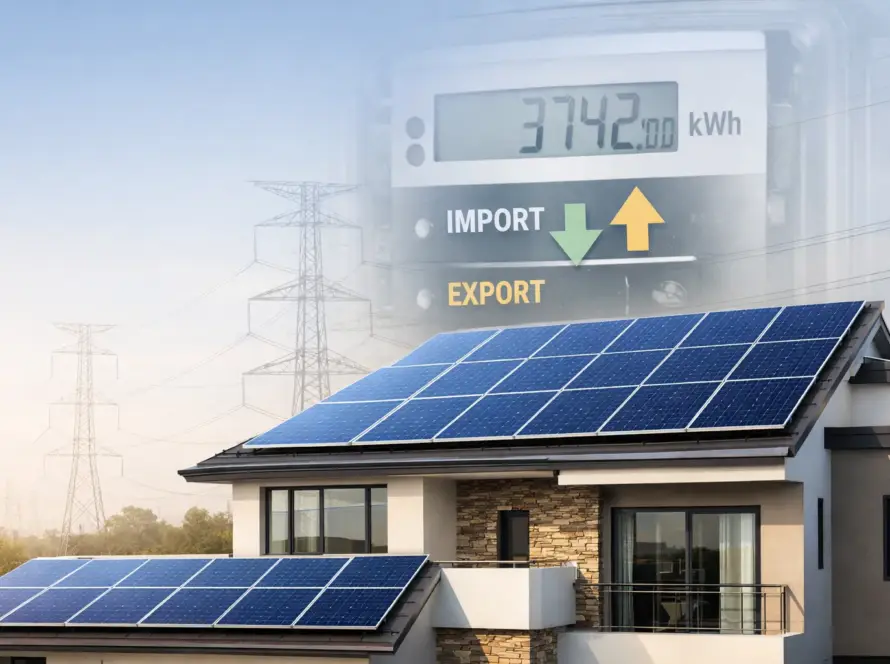
Net billing vs net metering in Pakistan differs mainly in how exported solar electricity is credited. Net metering offsets units at retail electricity rates, while net billing pays a lower buyback rate for exported units under updated NEPRA rules, significantly affecting solar savings and payback periods in 2026.
This comparison is based on Pakistan’s latest solar policy changes. For a complete breakdown of how the shift happened, see our Net Billing Update 2026 in Pakistan.
Key Takeaways
- Net metering adjusts exported units against consumed units at retail rates
- Net billing pays a fixed buyback rate for surplus solar electricity
- NEPRA has shifted Pakistan toward net billing for new connections
- Solar ROI and payback periods are longer under net billing
- Choosing the right system depends on usage patterns and system size
Understanding Net Metering in Pakistan
Net metering in Pakistan allows solar system owners to export excess electricity to the national grid and offset it against their consumed units. This system has historically made solar installations highly profitable for residential and commercial users.
How Net Metering Works
Solar panels generate electricity during the day. Any unused electricity is exported to the grid and recorded through a bi-directional meter. At the end of the billing cycle, exported units are deducted from imported units.
Net Metering Policy Pakistan
Under the National Electric Power Regulatory Authority (NEPRA) framework, net metering customers previously benefited from unit-to-unit adjustment at consumer tariff rates.
Benefits of Net Metering
Net metering offered faster payback periods, higher monthly bill reductions, and long-term energy independence, which fueled Pakistan’s rapid solar adoption over the past decade.
Understanding Net Billing in Pakistan
Net billing is the updated solar compensation mechanism where exported electricity is purchased by the grid at a predefined rate rather than adjusted against consumed units.
How Net Billing Works
Under solar net billing Pakistan rules, consumers pay full retail electricity rates for imported units, while exported solar units are credited separately at a lower buyback tariff.
Net Billing Policy Pakistan
The net billing policy Pakistan follows revised NEPRA net billing rules, aiming to balance grid sustainability and reduce cross-subsidy pressure caused by traditional net metering.
Why Pakistan Shifted to Net Billing
The transition was introduced to protect distribution companies (DISCOs), stabilize national revenue, and manage increasing rooftop solar penetration.
Net Billing vs Net Metering Difference (Side-by-Side Comparison)
| Feature | Net Metering | Net Billing |
|---|---|---|
| Export unit value | Retail electricity rate | Fixed buyback rate |
| Monthly adjustment | Unit-to-unit | Monetary credit |
| Solar ROI | Faster | Slower |
| Payback period | 3–5 years | 5–7+ years |
| Policy status | Limited for new users | Default system (2026) |
Info Box:
Net metering vs net billing difference becomes most noticeable for homes exporting large surplus electricity during daytime hours.
Impact of Net Billing on Solar Savings & ROI
Electricity Bill Reduction
While net billing still reduces electricity bills, savings are lower compared to net metering due to reduced export compensation.
Solar Payback Period
Net billing increases payback timelines, especially for oversized solar systems producing excess energy beyond household consumption.
Is Solar Still Worth It?
Yes solar remains viable in Pakistan, but system sizing, self-consumption, and battery integration are now more important than ever.
Note Box:
Solar systems optimized for self-use perform better under net billing than export-heavy setups.
Which System Is Better for You?
Residential Homes
Homes with daytime electricity usage benefit more from net billing since self-consumed energy avoids grid purchase entirely.
Commercial Users
Businesses operating during daylight hours can still achieve strong ROI even under net billing Pakistan regulations.
System Size Matters
Oversized systems exporting large volumes to the grid are less profitable under net billing rules.
NEPRA Rules & Regulatory Outlook (2026)
The updated NEPRA net metering regulations and net billing framework indicate a long-term policy shift. New applicants should expect net billing to remain the standard unless future amendments occur.
Alert Box:
Installing solar without understanding net billing vs net metering Pakistan rules can lead to unrealistic ROI expectations.
Solar Installation Guidance by AYME Solar
If you’re planning solar under the new billing framework, system design matters more than policy labels.
AYME Solar Solution specializes in designing solar solutions optimized for net billing Pakistan, focusing on:
- Maximum self-consumption
- Accurate load analysis
- Cost-effective system sizing
- Long-term energy savings compliance
Learn more at aymesolar.com and get expert guidance before investing.
Want the right solar setup under net billing? Get a quick ROI estimate and system sizing from AYME Solar.
Get a Free Solar ConsultationFinal Thoughts
The shift from net metering to net billing marks a major change in Pakistan’s solar landscape. While savings structures have evolved, solar energy remains a smart long-term investment when systems are properly designed for the new regulatory environment.
FAQs – Net Billing vs Net Metering Pakistan
The main difference is compensation. Net metering offsets exported units at retail rates, while net billing pays a fixed buyback rate for exported electricity, resulting in lower overall solar savings.
Net metering availability is limited for new applicants. Most new solar connections are approved under net billing Pakistan rules as per updated NEPRA regulations.
Yes, net billing reduces electricity bills, especially through self-consumed solar energy. However, savings from exported units are lower compared to net metering.
Net metering is more profitable, but net billing is now the standard system. The better option depends on usage patterns, system size, and self-consumption levels.
The solar buyback rate under net billing is set by NEPRA and is lower than retail electricity tariffs, making export-heavy systems less attractive.
Yes, solar is still worth installing in Pakistan, especially for users with high daytime consumption and well-planned system designs.
Existing net metering customers generally remain on their approved framework, while new installations fall under net billing unless policy revisions allow otherwise.